
After Dark Guide
Soffit Lighting: How It Mounts and Why It Disappears by Day
Soffit lighting tucks LEDs into the underside of your roofline so the house glows at night and looks ordinary by day. How it mounts, and what goes wrong.
Soffit lighting is exactly what it sounds like: lighting set into the soffit, the horizontal underside of your roof overhang, so light washes down and out along the architecture. Done well it is the cleanest way to light a house, because the hardware lives up in the eave where nobody looks. The house glows after dark and looks completely ordinary in daylight.
That is the short version. The longer version is worth reading, because “soffit lighting” gets used loosely for at least three different installs that behave nothing alike, and the difference decides whether yours looks built in or bolted on.
Soffit, fascia, or eave: three mounts, three results
Most articles use these interchangeably. Installers do not.
Soffit mount. The channel goes on the horizontal underside of the overhang, facing down, so light falls straight down the wall. This is the most hidden option, because from the street you are looking up into a shadowed surface and the hardware is genuinely out of sight. It also needs a deep overhang to work properly. A shallow eave puts the light source close to the wall and you get a hot band at the top instead of an even wash.
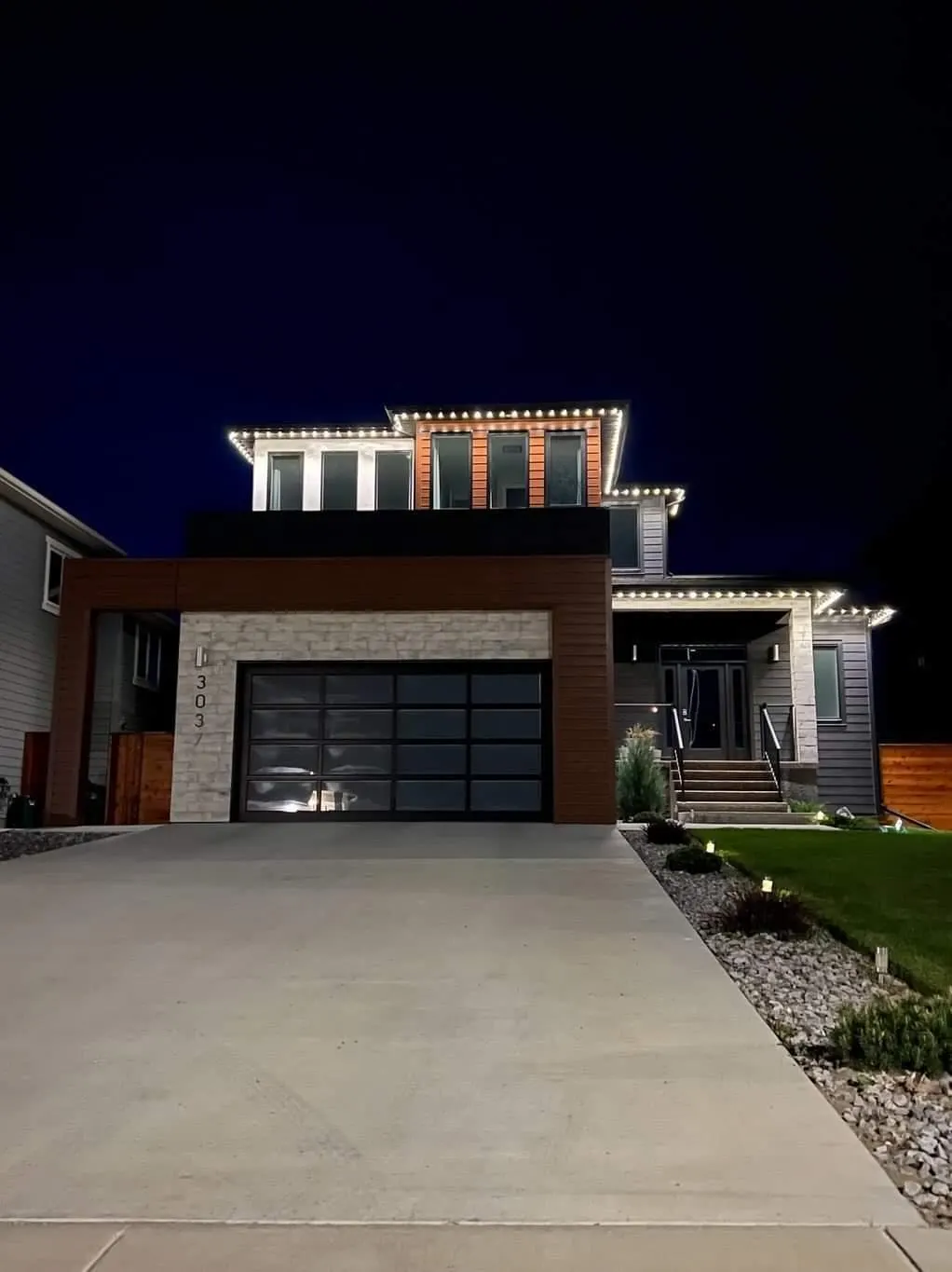
Fascia mount. The channel goes on the vertical board at the roof edge, the same trim your gutters hang from, facing out and slightly down. Light traces the roof edge rather than washing the wall. This is what most people picture when they picture permanent Christmas lights, because it draws the outline of the building. On a house with strong roof geometry, gables, dormers, a wraparound porch, it is usually the better looking of the two.
Eave or under-eave mount sits between them, angled into the corner where soffit meets fascia. It is a compromise, and it is the right answer more often than either purist option, particularly on newer stucco homes with shallow overhangs.
Which one suits your house is decided by the house, not by preference. A two-story stucco home in Starkey Ranch with a shallow eave and a strong roofline wants fascia. A Palm Harbor ranch with deep overhangs and a long low wall wants soffit. We work it out on the walk, and anyone specifying one of them sight unseen is guessing.
What actually makes it disappear
The disappearing act is not the fixture. It is three things, in order of how much they matter.
The channel is finished to match. The extruded aluminum track is coated or wrapped to your soffit or fascia color before it goes up. Beige on beige, white on white, bronze on bronze. From the curb your eye reads it as trim, because functionally that is now what it is.
The diodes are recessed, not surface mounted. In a proper system the LED sits back inside the channel rather than proud on a strip. In daylight you are looking at a shadowed groove. At night you get the light without staring at a row of bright dots.
The wire is inside the channel. This is the one that separates a real install from a retrofit that looks like a retrofit. Consumer kits run a visible cable and clip it up. A permanent system runs low-voltage line inside the track and into the soffit cavity, so there is nothing to see and nothing for the wind to pull on.
Skip any of the three and the system is visible by day, which defeats the entire point of putting it in the soffit.
The white light question, which decides everything else
You will use warm white far more than you will use color. That is not a preference, it is what people actually do: most set the system to warm white and leave it there for something like 340 nights of the year, then use color for the holidays and a handful of occasions.
So judge a system on its white.
Cheaper systems use RGB diodes and fake white by mixing red, green and blue. It lands cool and slightly clinical. Fine for a December display, wrong for everyday. Better systems use RGBW, where a fourth diode is dedicated to warm white and produces it directly rather than blending toward it. That is the difference between a house that looks finished and a house that looks lit up.
If you are comparing systems, ask that first and ask about the color features second. Our permanent architectural lighting page covers what we install and why, and the comparison against clip-on kits goes into the white in detail.
Florida soffits specifically, because they are not like other soffits
This is where generic advice stops being useful.
Most soffit around Tampa Bay is vinyl or aluminum, not wood. Vinyl panels flex, expand in heat, and are not a structural fixing point. A track fastened only into vinyl will sag within a season. It has to reach the framing behind, or go onto the fascia board instead, which is one practical reason fascia mount is common here even when the customer asked for soffit.
Soffit is vented, and the venting matters. Perforated panels are how your attic breathes. Blocking a meaningful run of vent with solid channel is a genuinely bad idea in this much humidity. A good layout works with the vent pattern rather than across it.
Storm season is the real test. Sustained wind and horizontal rain find every fastener driven in optimistically and every splice that was not sealed. Along the coast, in Hudson, the Gulf Harbors canals in New Port Richey, out on Clearwater’s Island Estates, salt does the rest. That is most of what separates an install that lasts from one that becomes a service call every spring, and none of it is visible on the day the job finishes.
Nothing should penetrate the roof field. Soffit and fascia are trim, not roof. A properly designed system stays entirely off the shingles or tile. That matters for warranty and it matters more in a state that tests roofs annually. There is a full guide on whether permanent lighting damages your roof.
Retrofit versus new construction
Both are routine. They are not the same job.
On an existing home the channel is fitted to what is already there, which means working around gutter hangers, downspouts, existing vent runs, and whatever the last contractor did. Nothing gets torn off, and the install is a day for most houses.
On new construction, or during a re-roof or soffit replacement, you get an option you will never get again: run the low-voltage line before the soffit closes up. If you are building or renovating anywhere in Tampa Bay and think you might ever want this, say so while the eave is open. Pulling wire into an open cavity costs almost nothing and is fiddly afterwards.
What it costs, and why nobody publishes a number
Cost tracks linear footage of roofline and how many stories the crew is working at. A single-story ranch with a simple roof is straightforward. A two-story home with gables, dormers and a detached garage is several times the run and several times the setup.
That is why we do not publish a flat price, and why you should be skeptical of anyone who quotes one over the phone without seeing the roofline. We measure what you want lit and hand you one written price with no obligation. Financing is available.
The comparison worth making is not against a box of clip-on lights. It is against paying a crew to hang and remove seasonal lighting every year forever. For a homeowner already doing that, a permanent system typically pays for itself in about two years, and after that the holiday lighting is effectively free while you also get warm white every other night.
How long it lasts
LED lifetime is usually quoted as an L70 figure: the operating hours before light output falls 30 percent below new. It is measured under IES standard LM-80, and the US Department of Energy’s fact sheet on lifetime and reliability of LED lighting explains why one number never tells the whole story. Quality outdoor products carry L70 ratings in the tens of thousands of hours, which at dusk-to-dawn use is years rather than seasons.
In practice the diode is not what fails. Connections are. Which brings it back to the install.
The mistakes we get called out to fix
- Stick-on strips in the soffit. Adhesive does not survive a Florida summer in a vented eave. They sag, then drop.
- Track fastened into vinyl only. Perfect on day one, waving at you by August.
- Warm white that is not warm. An RGB system faking white, usually bought on the strength of a color demo.
- Vent runs blocked. Rarely noticed until an attic humidity problem turns up somewhere else entirely.
- Visible wire. One cable run outside the channel undoes the whole invisible-by-day premise.
- A layout that ignores the architecture. Tracing every edge including the ones nobody looks at, which reads busy rather than designed.
Common questions
Is soffit lighting the same as permanent Christmas lights? Same hardware, different framing. “Permanent Christmas lights” describes what people buy it for, “soffit lighting” describes where it goes. One system that runs warm white nightly and color whenever you want it.
Can it go on a house with no soffit? Yes. Homes with minimal or no overhang take a fascia mount, which frequently looks better anyway on strong roof geometry.
Will it light up the yard? No, and this is worth being clear about. It washes the building. Trees, beds, paths and driveways need fixtures at ground level, which is landscape lighting and a separate design.
Does it work on a tile roof? Yes. Tile makes the roof field itself more delicate and more expensive to repair, which is exactly why a system that lives on the soffit and fascia and never touches the tile is the right approach here.
Can I install it myself? You can buy something and put it up. What is hard at homeowner level is color-matching extruded channel to your trim, running line inside the track and into the cavity, sealing connections to survive salt air, and keeping the whole thing off the roof field. That gap is most of the visible difference.
If you want to know what it would look like on your own house, the design consultation is free and you get one written price with no obligation.
Want this on your home?
Book a free design consultation. We will walk your property, design the look around your rooflines, and hand you a clear written quote with no obligation.