After Dark Guide
How Much Do Permanent Christmas Lights Cost in Florida?
Professionally installed permanent Christmas lights run about $18 to $40 per foot, or roughly $3,000 to $6,000 for a typical Florida home. Here are the real, cited numbers.
Search “permanent Christmas lights cost” and you get a wall of numbers with no context: $22 a foot on one page, $8,000 on the next, a $299 kit from a box store in the ad beside them. All three can be true, because they are pricing three different things. Below are the real, current ranges from published brand and industry data, what actually sets your number, and the one comparison that decides whether a permanent system is worth it for your home at all.
What permanent Christmas lights actually cost
A professionally installed permanent lighting system runs roughly $18 to $40 per linear foot, which works out to about $2,000 to $8,000 for most homes covering 100 to 200 feet of roofline. Those figures come from installer pricing at Trimlight, which lists $18 to $35 per foot installed, and a 2025 cost roundup from Govee, which puts professional installs at $20 to $40 per foot and $2,000 to $8,000 total for 100 to 200 feet.
Most homeowners land in the middle. JellyFish Lighting reports that most of its customers spend between $3,000 and $6,000, with an average around $4,600 for the street-facing sides of a home, in pricing dated September 2026.
Here is how that tends to break down by home, using those published rates:
| Home | Roughly | Typical installed range |
|---|---|---|
| Single-story, front roofline only | 80 to 120 ft | $1,800 to $4,000 |
| Single-story, full perimeter | 120 to 170 ft | $3,000 to $5,500 |
| Two-story traditional | 170 to 250 ft | $4,500 to $8,000 |
| Estate or complex roofline | 300+ ft | $8,000 and up |
None of these is your price. They are what the market charges, and every roofline is different, which is why we measure and quote your exact home for free instead of reading you a number off a chart.
How installers price a permanent system
Almost every professional prices by the linear foot of roofline you want lit, not by the square footage of your house. A 4,000 square foot home with a simple front-facing roof can cost less to light than a smaller home with peaks, dormers, and a wrapped porch. A few things move the per-foot rate:
- How many sides. Just the front roofline is the cheapest option. All sides, plus peaks and a porch, is more line and more labor. JellyFish prices from front-only up to the full perimeter.
- Roofline complexity. Multiple peaks, dormers, and a second story add time and material.
- The LED tier. A single-diode outward-facing light costs less than a downward-facing RGBW puck. A LuxLights breakdown from September 2026 runs from about $1,500 per 100 feet for a basic single-LED system to $3,000 to $4,500 per 100 feet for a six-diode RGBWW downward-facing system.
- The controller. The brain that runs the color and scheduling is a real line item. JellyFish lists controllers at $650 to $850, with one controller powering up to 263 feet of light.
- Region and time of year. Rates shift by market and by how close you book to the holiday rush.
What it costs by the size of your home
Most brands quote custom, but a couple publish their starting numbers, which is useful for sizing up your own home. Oelo lists installed starting prices by footage, and an authorized Gemstone Lights dealer publishes a flat $22.50 per foot installed. Side by side:
| Roofline | Oelo installed (starting) | Gemstone at $22.50/ft |
|---|---|---|
| 100 ft | $3,750 | $2,250 |
| 150 ft | $5,171 | $3,375 |
| 200 ft | $6,534 | $4,500 |
| 250 ft | $8,138 | $5,625 |
Read those as floors, not ceilings. Both note that a complex roof, a second story, or a peak-heavy design pushes the real number up. What they show clearly is the shape of the cost: a mid-size home around 150 feet of roofline lands somewhere between about $3,375 and $5,250 across the mainstream installed brands.
What the major brands charge
The installed track systems cluster in a tight band, and a budget do-it-yourself tier sits well below them:
- JellyFish Lighting. $25 to $35 per foot installed, $3,000 to $6,000 for most homes, average around $4,600. Controllers $650 to $850. (source)
- Gemstone Lights. $22.50 per foot installed through the dealer above, roughly $3,375 for a 150-foot home. (source)
- Trimlight. $18 to $35 per foot installed. (source)
- Oelo. Installed starts at $3,750 for 100 feet and $5,171 for 150 feet. (source)
- Govee, the budget do-it-yourself option. Not a professional install. The clip-on strips run about $2.99 a foot for the basic line, with finished kits at $759.99 and $859.99, and do-it-yourself materials landing in the $300 to $2,000 range. (source)
That gap between a $3-a-foot Govee strip and a $30-a-foot installed system is not only labor. The systems at the top of the range use downward-facing RGBW pucks with a dedicated warm-white diode, so the everyday white reads as a true warm white instead of the bluish cast a strip makes when it mixes its own white from red, green, and blue. If a soft warm white on ordinary nights is the point, and for most of our clients it is, that diode is a real part of what you are paying for. A clip-on strip is a legitimate choice at a different price and a different job; it is just not the same product.
Permanent versus traditional C9: two products, two costs
This is where people mix apples and oranges, so it is worth separating cleanly.
Traditional holiday lighting is a seasonal service. We hand-hang commercial-grade C9 bulbs along your rooflines, keep them running through the season, then take them down and store them in January. The color is fixed for the season, and it is the classic round-bulb Christmas look most people picture. Because it is essentially a rental, you pay for it again every year. Our Christmas light installation cost guide covers those seasonal numbers in full.
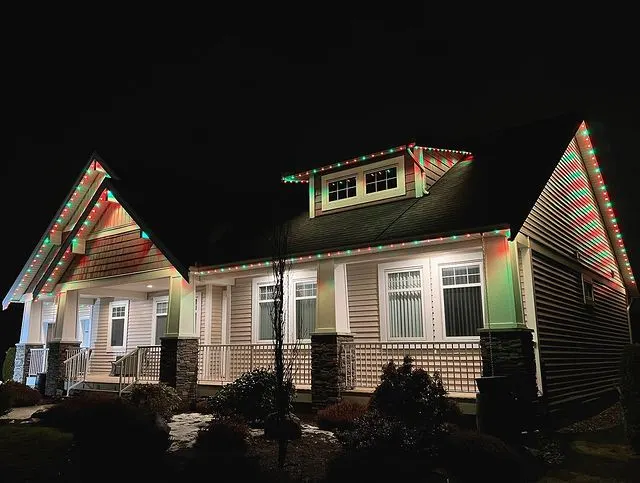
A permanent architectural lighting system is a different product entirely. A slim, color-matched track sets into your eave and holds app-controlled full-color RGBW LEDs. It never comes down. It runs a soft warm white on ordinary nights, then switches to red and green for Christmas, orange for Halloween, or red, white, and blue for the Fourth, all by zone from your phone. You are not renting a look for three weeks; you own hardware that covers the holidays plus every other night of the year. The permanent versus temporary guide walks through the trade in detail.
Do not compare the two on sticker price alone. One is a recurring service, the other a one-time purchase, and the only fair way to weigh them is over several years.
The payback math, in real numbers
Here is the comparison that actually decides it.
A seasonal C9 install in Florida runs about $350 to $1,000 for a standard home, or $3 to $8 per foot, per Florida installer Griswold’s Christmas Lights, with a two-story landing at the higher end. Call it $600 to $1,000 a year for a typical home, every year, with nothing owned at the end.
A permanent system on that same 150-foot home is roughly $3,375 to $5,250 installed, one time. Do the division. A homeowner paying $700 a season breaks even in about five years. One paying $1,000 a season, which is the figure JellyFish cites for hiring a seasonal crew, breaks even in about three. Trimlight puts the break-even at two to four years. After that point the holiday lighting is effectively free, and you also get warm white on the 300-plus other nights of the year, which a seasonal C9 job never gives you.
The honest fork: if you only want lights for three weeks in December, and you love the specific look of round C9 bulbs, the seasonal service is the smarter spend, full stop. A permanent system earns its cost from year-round use and from never paying a crew again. If you are not going to use it the other eleven months, do not buy it for the math.
What is different about pricing a Florida roofline
The national cost guides above do not account for the Gulf Coast. A few things are particular to lighting a home in Tampa Bay or Tarpon Springs, and they matter before you compare quotes:
- No snow, a long season. The national numbers assume a snowy December. Here, the value case is different: warm white reads beautifully on stucco-and-tile homes for 365 nights, so you are buying a year-round finish, not a three-week display.
- Tile and metal roofs. Barrel tile and standing-seam metal are common across the area, and both need mounting that will not crack a tile or void a roof warranty. A permanent track fastens to the fascia or soffit, never through the roof, which is part of why it survives here.
- Heat, humidity, and afternoon storms. Every connection has to be sealed and run low-voltage to a proper outdoor outlet. This is exactly the condition where cheap clip-on strips fail, and it is worth paying to do right.
- HOA rules. Because the color-matched track all but vanishes against the trim in daylight, a permanent system is usually far easier to get past an HOA than strands left up year-round.
- Palms and two-story coastal traditionals. Wrapped palms and tall, complex rooflines add footage and height, and height is the single biggest driver in any install.
Why the cheapest quote is rarely the cheapest
A cut-rate permanent job usually shows up in one of three ways: a clip-on strip that sags off the eave after the first storm season, an RGB-only system whose everyday white looks faintly blue, or a bargain install with no real warranty on the track. Any of those means you are back up the ladder, or paying again, inside a couple of years. Before you sign anything, ask any company, us included, to put these in writing:
- The exact linear footage and which rooflines, peaks, and porches are covered.
- The LED tier: single-diode or downward-facing RGBW, and whether it has a dedicated warm-white diode.
- The controller, and how many feet it powers, so the system can actually reach your whole home.
- The mounting method for your specific roof type, tile or shingle or metal.
- The warranty on both the hardware and the workmanship, not just the bulbs.
A quote that spells all of that out is almost always the more honest one, even when the bottom line is higher than a strip-and-go competitor who leaves the tier, the controller, and the warranty out of the fine print.
We do not publish a flat per-foot price, because a barrel-tile two-story in Tarpon Springs and a single-story stucco ranch price out differently, and it would be dishonest to pretend one number fits both. We measure your home, design the zones, and hand you a written number at no charge.
Common questions
How much do permanent Christmas lights cost for an average home? Most homeowners spend $3,000 to $6,000, with an average around $4,600, at roughly $18 to $40 per linear foot installed. A mid-size home near 150 feet of roofline typically lands between about $3,375 and $5,250 across the mainstream installed brands.
Why are they so much more than the $300 kit I saw online? Because they are a different product. The kit is a clip-on strip you mount yourself. An installed system is a color-matched track set into your trim, with downward-facing RGBW pucks, a controller, weatherproofing, and a warranty, put up by a crew. Both are valid at their price; they are not the same thing.
Do permanent lights really pay for themselves? For a homeowner already paying to have lights hung and pulled every December, yes. Against a $600 to $1,000 seasonal bill, a permanent system typically breaks even in about three to five years, and Trimlight puts it as low as two to four. After that the holiday lighting is essentially free and you also get warm white year-round. If you only ever want lights at Christmas, the seasonal C9 service is the smarter spend.
Will you give me a price over the phone? No, and for a good reason. Your number depends on footage, height, roof type, and the LED tier you choose. A phone quote would either be a lowball to get in the door or padded to be safe. We would rather measure it and give you the real one.
If you want a real number for your home instead of a range off a chart, start with a free design consultation. We will lay out both the seasonal and the permanent option, with a written, no-obligation quote, so you can make the call on the actual math.


Want this on your home?
Book a free design consultation. We will walk your property, design the look around your rooflines, and hand you a clear written quote with no obligation.