
After Dark Guide
How Much Does Christmas Light Installation Cost in Florida?
Professional Christmas light installation in Florida runs about $350 to $1,000 for a standard home, or roughly $3 to $8 per foot. Here are the real numbers and what sets yours.
The honest answer to “what does it cost to have my Christmas lights hung” is that it depends on your home, and anyone who reads you a flat number over the phone is guessing. But you do not have to fly blind. Below are the real market ranges from published cost data, what actually moves your number, and how to size up your own house before you ever call.
What professional Christmas light installation actually costs
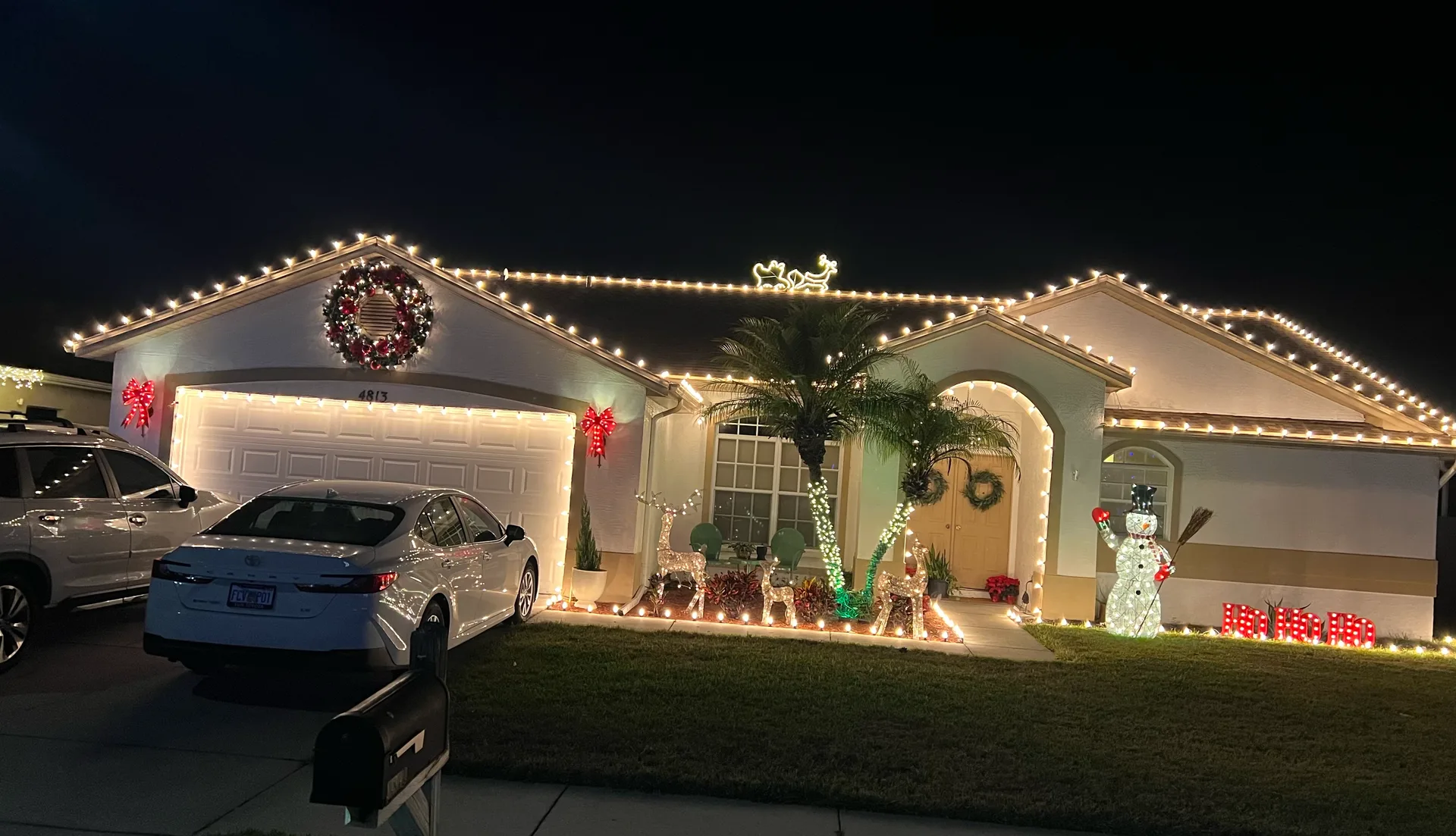
Nationally, homeowners pay an average of about $444, with most jobs landing between $220 and $684, according to HomeAdvisor’s cost data. Closer to home, Thumbtack puts the Palm Harbor area range at $260 to $661. Across Florida as a whole, a standard seasonal setup tends to run a bit higher, roughly $350 to $1,000, per Florida installer Griswold’s Christmas Lights.
Here is how it typically breaks down by home, using Florida figures:
| Home | Roughly | Typical range |
|---|---|---|
| Single-story ranch, front roofline | 100 to 150 ft | $350 to $600 |
| Two-story traditional, wrapped | 150 to 250 ft | $600 to $1,200 |
| Estate or custom layout | 300+ ft | $1,500 to $5,000+ |
| Palm or tree wrapping | per tree | $100 to $500 |
None of these is your price. They are what the market charges, and every roofline is different, which is why we measure and quote your exact home for free instead of reading you a number off a chart.
How installers actually price it
Almost every professional prices by the linear foot, meaning the length of roofline, railing, or greenery you want lit. All in, that runs about $2.50 to $7 per foot nationally per HomeAdvisor, and closer to $3 to $8 per foot in Florida once you include custom-cut light runs per Griswold’s. A few things move that rate:
- If you already own your lights, you are paying labor only, roughly $1.25 to $3 per foot (Thumbtack).
- If the installer supplies commercial-grade strands, add about $0.50 to $2 per foot (Thumbtack).
- A second story usually costs about twice what the first story does, and difficult roof access can add around 20 percent (Thumbtack).
- Takedown and storage are part of a real job, usually another $100 to $400 (HomeAdvisor).
That last point is the one people miss. You are not paying for an afternoon on a ladder. You are paying for the design, the install, the maintenance calls through the season, and a clean takedown in January.
What it costs to light 200 feet
This is one of the most common numbers people search, so here is the real math. Two hundred feet is roughly a single-story home with the front and both sides outlined. At the standard all-in rate of $2.50 to $7 per foot, that is about $500 to $1,400. In Florida, at $3 to $8 per foot, figure $600 to $1,600. If you already own your lights and only need them hung, labor alone runs closer to $250 to $600, which is 200 feet at $1.25 to $3 per foot. Figures from HomeAdvisor, Griswold’s, and Thumbtack.
What moves the price in Florida specifically
The cost guides above are national and statewide. A few things are particular to lighting a home on the Gulf Coast, and they are worth knowing before you compare quotes:
- Tile and metal roofs. A lot of Tampa Bay homes wear barrel tile or standing-seam metal. Both need clips and methods that will not crack a tile or void a roof warranty, and that is slower, more careful work than stapling to a simple shingle fascia. It shows up in the quote.
- Palms and live oaks. Wrapping a palm trunk or lighting a mature oak is priced per tree, commonly $100 to $500 each, and a couple of wrapped palms flanking an entry can change a display more than another fifty feet of roofline.
- Height and pitch. Two-story coastal traditionals and homes with steep or complex rooflines take more time and rigging, which is the single biggest driver in any install.
- Weatherproofing. Florida humidity and afternoon rain mean every connection needs to be sealed and run to a proper outdoor, GFCI-protected outlet. Cutting that corner is how a display goes dark in the first storm.
- How much you want lit. A clean front roofline is a modest job. Adding the peaks, the palms, the walkway, and the entry is a bigger one. Footage is the number everything else multiplies against.
Traditional C9 versus a permanent system: the real cost fork
This is the choice that changes the math most.
Traditional holiday lighting is a seasonal service you pay for each year. We run commercial-grade C9 line, cut and fitted to your home, hang it, keep it running, then take it down and store it in January. It is the classic warm-white look, and because it is essentially a rental, the cost comes back around every season.
Permanent architectural lighting is the other route: a system installed once that never comes down and covers the holidays plus every other night of the year. It is a larger one-time cost. HomeAdvisor puts permanent systems around $3,500 on average, and Florida figures for smart LED track under the eaves run about $1,500 to $4,000 and up. The yearly labor then disappears. For a homeowner already paying a crew to hang and pull lights every December, a permanent system typically pays for itself in about three to five seasons. Our permanent versus temporary guide breaks that trade down in full.
Why the cheapest quote usually is not the cheapest
A cut-rate install almost always shows up in one of three ways: flimsy store-grade strands that fail partway through the season, no maintenance so a dark run stays dark until January, or a hang-and-go job with no safe takedown. You end up paying twice, or back on the ladder yourself after all. A professional install uses commercial-grade line, includes maintenance through the season, and comes down cleanly, which is most of what you are actually paying for.
What a good quote should spell out
Because there is no standard price, the way to compare two bids fairly is to make sure each one covers the same things. Before you sign anything, ask any company, including us, to put these in writing:
- The linear footage being lit, and exactly which rooflines, peaks, trees, and walkways are included.
- Whether the lights are commercial grade, and who owns them at the end of the season.
- That maintenance is included, so a burned-out run gets fixed without a new charge.
- That takedown and storage are in the price, with a rough window for each.
- The warranty on the workmanship, not just on the bulbs.
A quote that spells all of that out is almost always the more honest one, even when the bottom line is higher than a hang-and-go competitor who quietly leaves the takedown, the maintenance, and half the roofline out of the fine print. Comparing only the final number is how people end up paying twice.
Booking early is its own kind of saving
One cost has nothing to do with footage: availability. Crews take a limited number of holiday installs each season, and the best install windows fill well before the rush. Returning customers get first pick of the calendar. Waiting until December does not just risk a higher price, it risks there being no slot left at all, which is why the smart move is to lock in a date in late summer or early fall.
Common questions
How do you charge for putting up Christmas lights? By the linear foot, in almost every case, which is the length of roofline, railing, and greenery you want lit. All in, that is roughly $2.50 to $7 per foot nationally and $3 to $8 in Florida, with a second story running about double the first. A real quote also covers maintenance and takedown, not just the hang.
Why will you not just give me a price over the phone? Because a fair price depends on your specific home: the footage, the height, the roof type, and what you want lit. A phone number would either be a lowball to get in the door or padded to be safe. We would rather measure it and give you the real one.
Is it cheaper to just do it myself? Up front, yes. Over time, often not, once you count the ladder hours, the store strands you re-buy every year or two, and the risk of the job itself. Most people who hire a pro do it because they are done spending a weekend on the ladder, not only for the cost.
Does a permanent system really pay for itself? For homeowners already paying to have lights hung and pulled every year, it typically pays for itself in about three to five seasons, then keeps working. If you only ever want lights at Christmas, the seasonal service is the smarter spend.
If you want a real number for your home instead of a range off a chart, start with a free design consultation, and book early so you have a spot when the season hits.
Want this on your home?
Book a free design consultation. We will walk your property, design the look around your rooflines, and hand you a clear written quote with no obligation.