
After Dark Guide
Landscape Lighting or Permanent Roofline Lighting: Which Does Your House Need?
Two different products, sold by the same people, that solve different problems. Here is how to tell which one your house is actually asking for.
Almost every week someone calls us having already decided which one they want, and roughly half the time they have picked the other one by the end of the conversation. Not because we talked them into it. Because the two products fix different problems, and most people find that out only once somebody asks what is actually bothering them.
So here is the whole thing laid out, including the parts where one of them is the wrong answer.
The short version, if you only read one paragraph
Landscape lighting lights the property. Permanent architectural lighting lights the building. If what bothers you is that the yard disappears at night, the palms and the oaks and the walk up to the door, that is landscape. If what bothers you is that the house itself goes flat and dark the moment the sun drops, that is permanent. If both bother you, that is normal, and the order you do them in matters more than most people expect.
What each one actually is
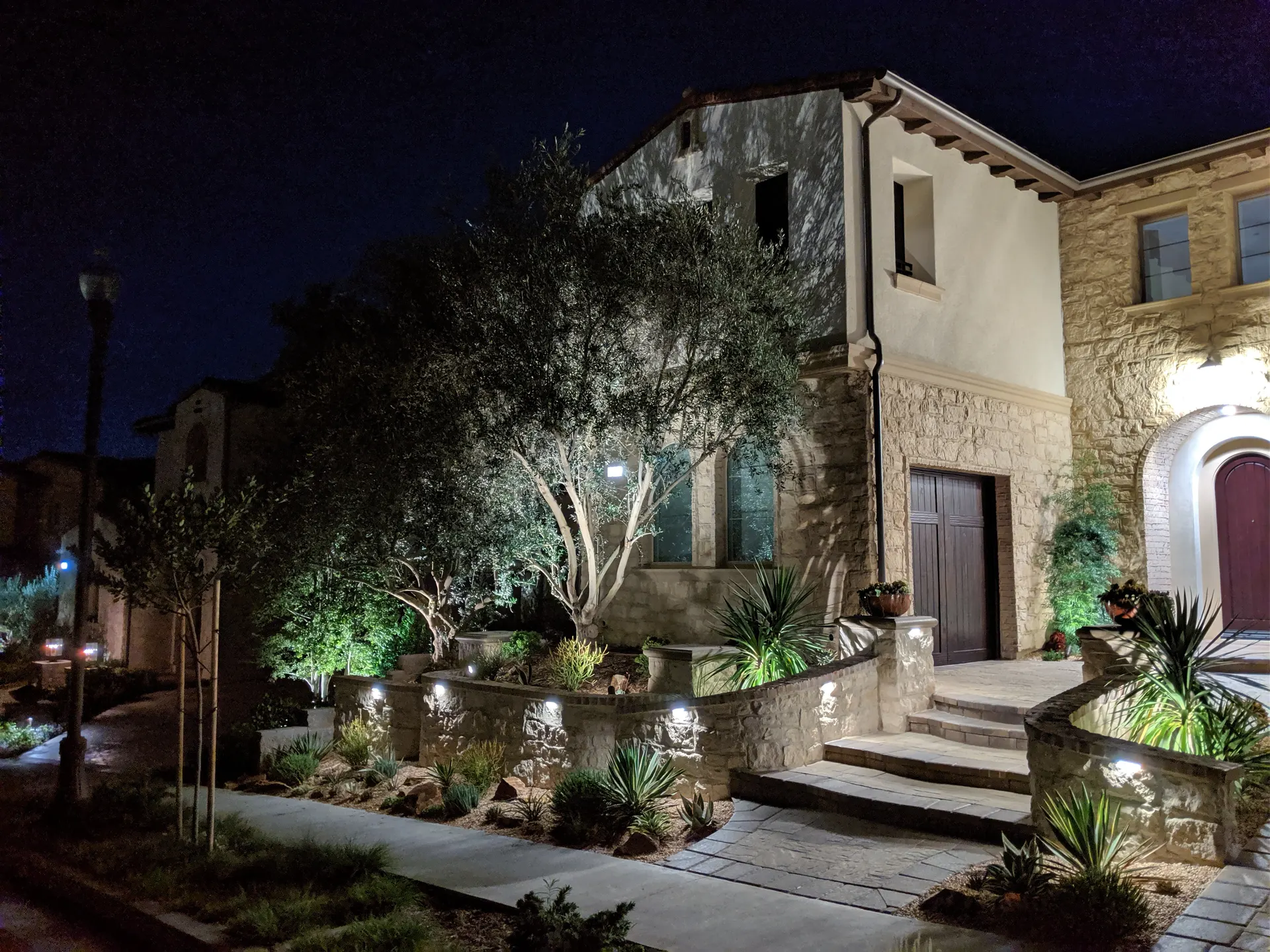
Landscape lighting is a set of individual low-voltage fixtures placed around your property and aimed. Uplights at the base of trees, well lights washing a stone facade, path lights along the walk, sometimes fixtures in the beds or on a dock. Each one is placed for a specific thing you want seen. It runs on a transformer, comes on with a timer, and the design lives in where the fixtures go and how they are aimed rather than in the hardware itself.
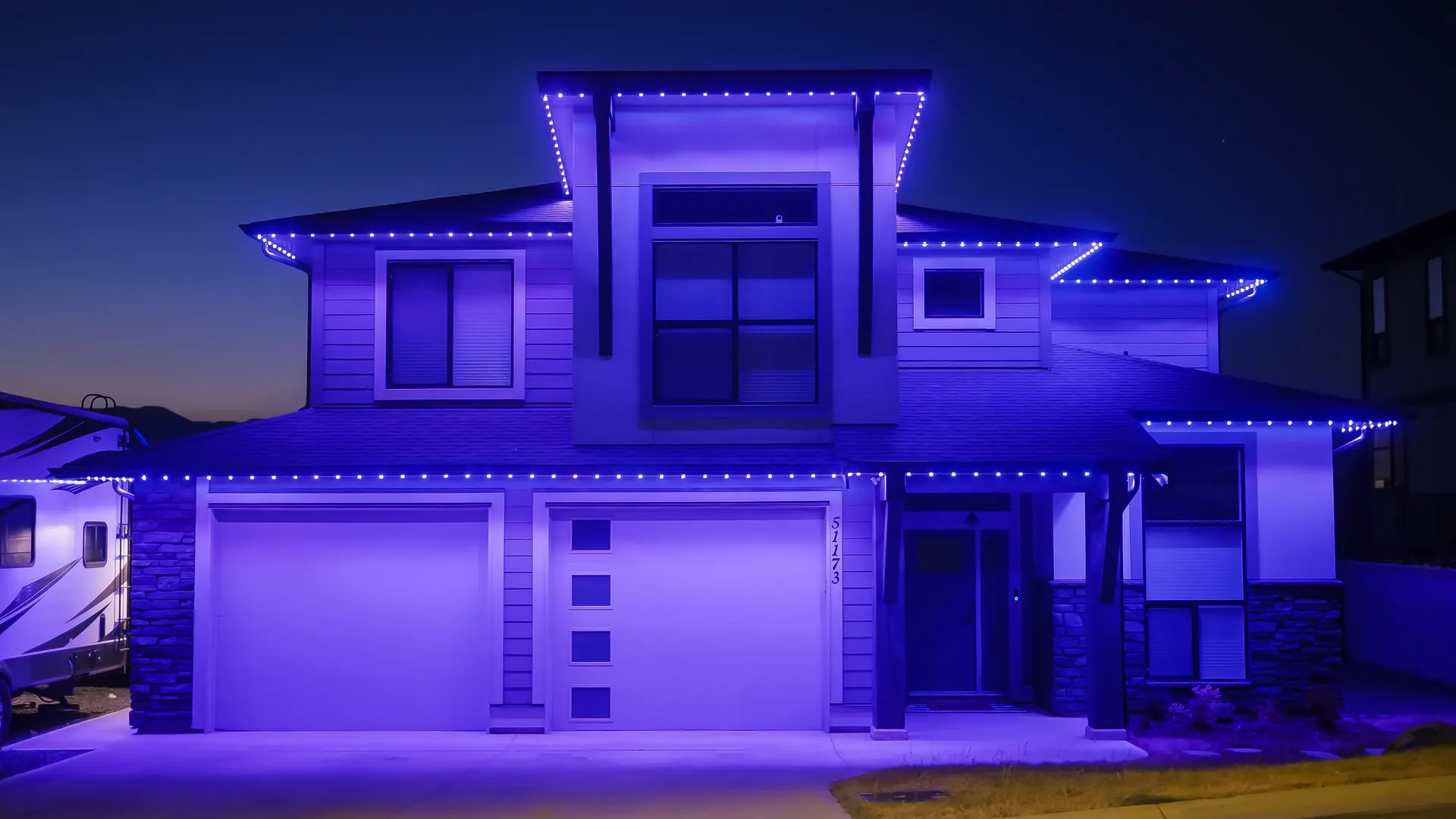
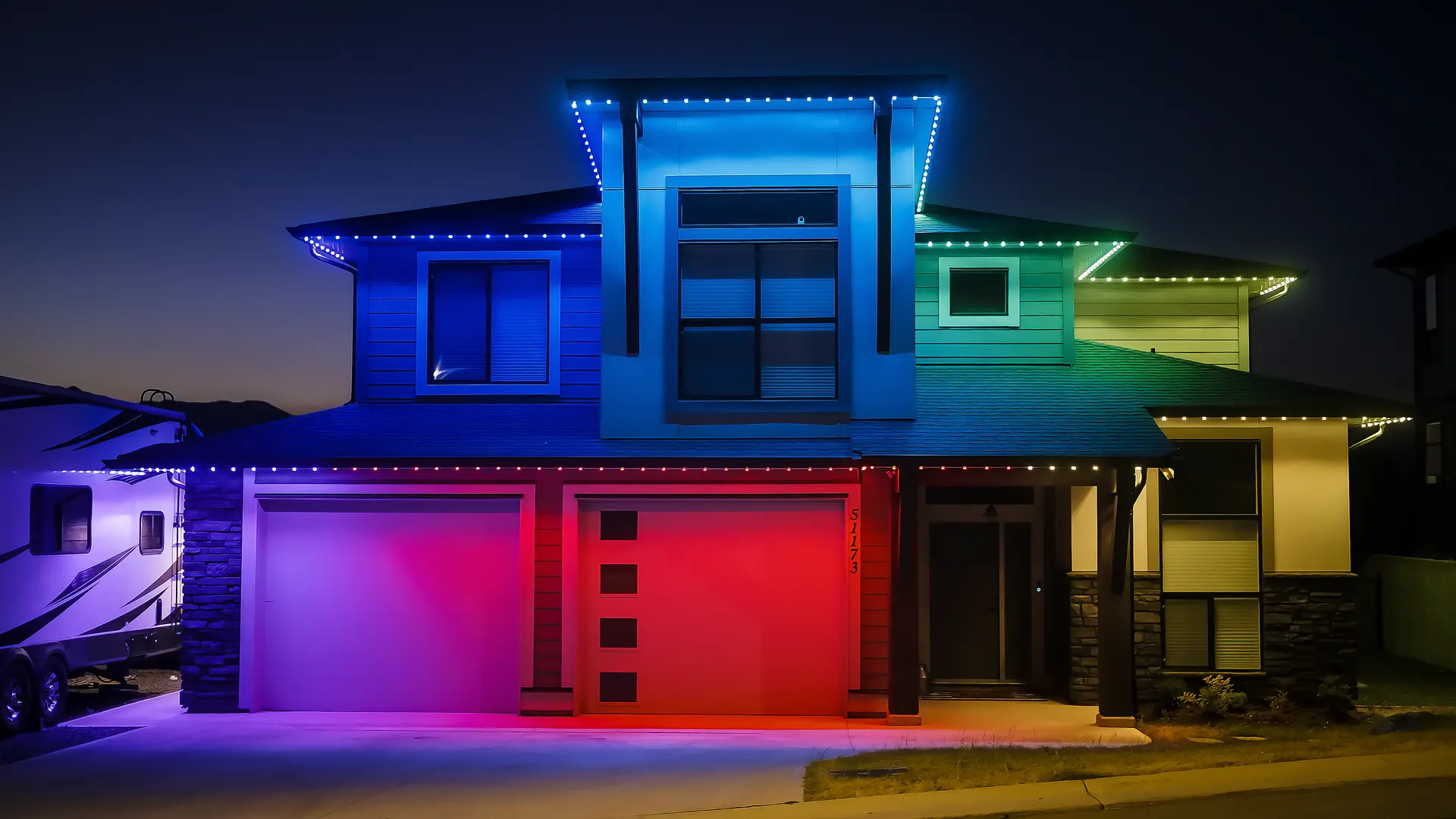
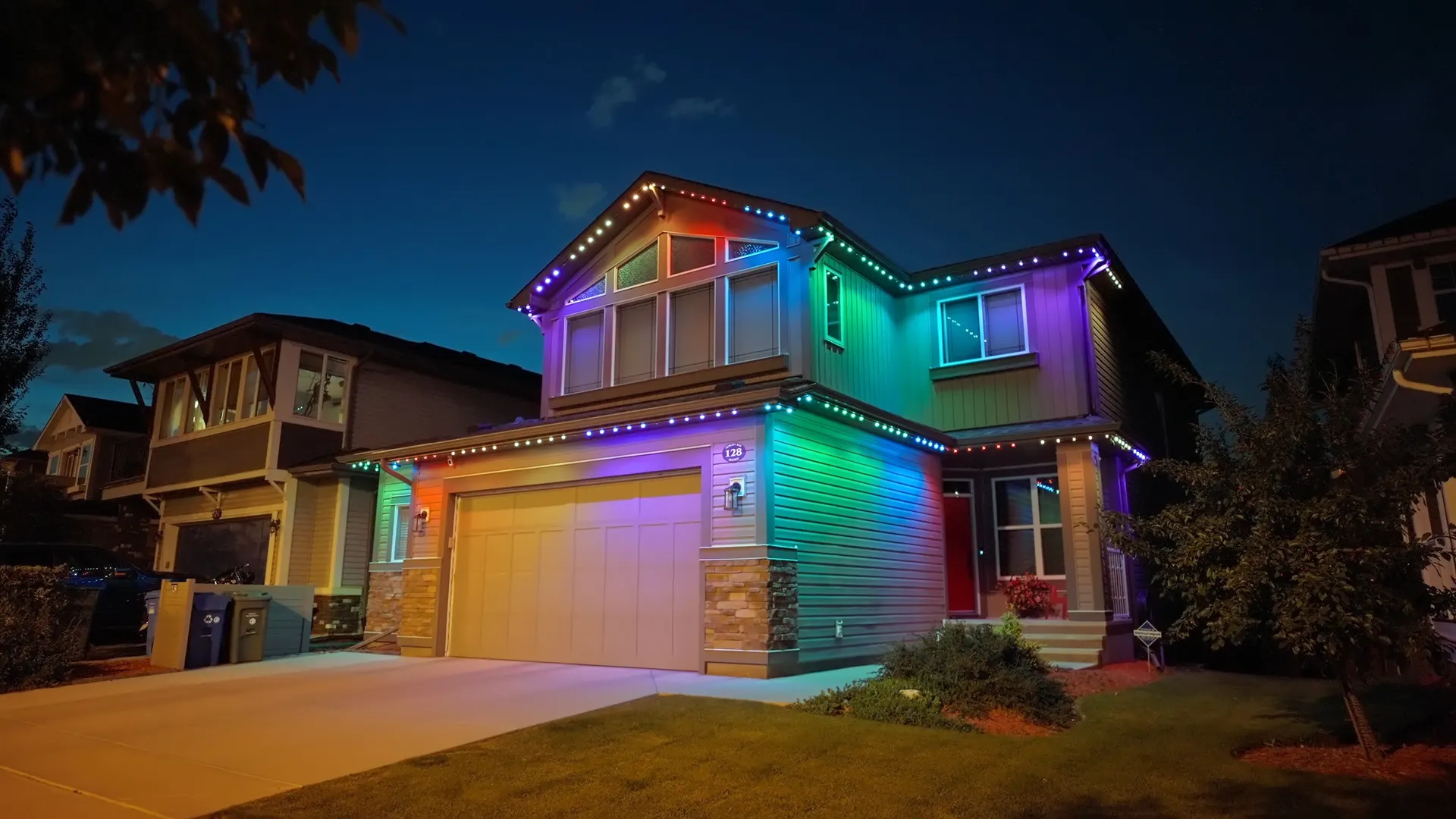
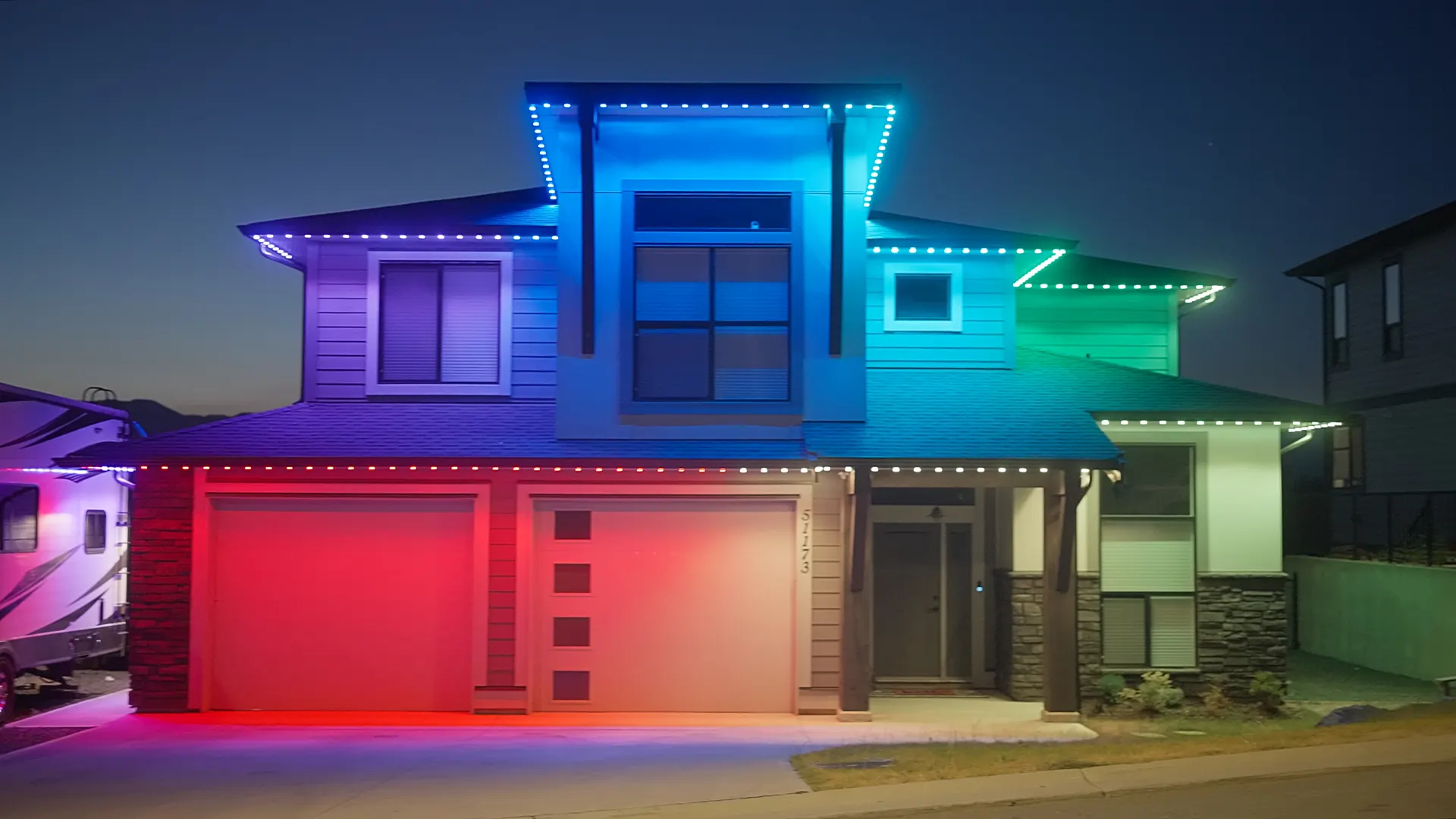
Permanent architectural lighting is a single continuous system built into the structure. A slim channel is mounted under the soffit along the roofline, finished to match your trim so it disappears in daylight, with a line of app-controlled LEDs inside it. It traces the geometry of the house. It runs warm white every night and switches to any color you want from your phone, which is why people also call it permanent Christmas lights.
They are both low voltage, both professionally installed, both designed to survive Florida. That is where the similarity ends.
The test: what are you actually trying to fix?
Forget the products for a minute and answer this. Stand at the curb after dark and look at your own place. What is the thing that annoys you?
“You can’t see anything back there.” That is landscape, and it is not close. A roofline system throws light out and down from the eave. It does nothing for an oak forty feet from the house, a path, a garden bed or a dock. If your property is the feature, fixtures on the ground are the only thing that lights it.
“The house looks like a black shape.” That is permanent. This one catches people out, because they assume more landscape lighting will eventually solve it. It will not. Uplighting a wall from the ground gives you a bright patch and a lot of shadow above it. Tracing the roofline gives you the outline of the building, which is the thing your eye actually reads as “that house is lit.”
“It just looks unfinished.” Usually permanent, and usually on newer construction. This is the most common one we hear in Trinity, Starkey Ranch and Land O’ Lakes, where the homes went up recently on tidy lots and the landscaping has not filled in yet. There is no canopy to light and not much in the yard yet, so the architecture is carrying the whole look and it needs help.
“It looks great except right at the door.” That is landscape, and it is a small job. Path lighting and a couple of well-aimed fixtures at the entry, done.
Where you live changes the answer more than you would think
This is not a national question, and anyone answering it without seeing your property is guessing.
On the big lots out in Odessa, Lutz and Keystone the answer is almost always landscape first. When a house sits well back behind mature oaks on two or five acres, the roofline is a small part of what you see from the road. The drive, the trees and the approach are the scene. Lighting the eave of a house you can barely see from the street is spending money in the wrong place.
In Trinity, Starkey Ranch, Bexley and the newer Wesley Chapel villages it flips. Tight lots, young landscaping, and every roofline on the block the same age and shape. There is nothing to uplight yet and nothing to hide fixtures behind, so the architecture does the work and the permanent system is what makes one house on the street read as yours.
On the water, in Hudson, Clearwater’s Island Estates, the Gulf Harbors canals in New Port Richey, there is a third answer: the dock and the water side often matter more than either, because that is where people actually spend the evening. That is its own conversation.
In the older neighborhoods, Palm Harbor’s Ozona, Tarpon Springs, St. Pete’s Old Northeast, you usually have both a canopy worth lighting and architecture with real detail worth tracing. Those are the properties where doing both genuinely pays, and where the order matters most.
Cost, honestly
We do not publish a flat price for either, and neither should anyone quoting you over the phone without seeing the roofline. What we can tell you is how the two behave differently.
Landscape lighting scales with fixture count. A modest entry and a few trees is a small job. Lighting five acres, a long drive and a dock is not. That means it is genuinely possible to start small and add later, and plenty of people do exactly that.
Permanent is closer to a fixed cost driven by linear footage of roofline and how many stories you are working at. There is no cheap version of it, and there is not much point doing half a house. But it is a one-time cost with no annual labor attached, which is the whole argument against paying a crew to hang seasonal lights every December.
Neither is a decision to make on price alone, because they do not do the same thing. A cheap version of the wrong product is worse value than the right one.
Can you do both, and does the order matter?
Yes, and yes.
If you are seriously considering both, the useful thing is to say so at the design walk, even if you only intend to buy one this year. We would rather lay out the whole property once and light the yard around a roofline plan that exists than light the yard first and then work around it later. Transformer placement, run routing and where the fixtures aim all change depending on whether the house is going to be lit.
The other thing worth knowing, and this is the part almost nobody expects: once the yard is lit, the house tends to look darker than it did before. Nothing changed up there. There is just now something bright sitting next to it, and your eye adjusts. We see it on nearly every landscape-only install, and it is the single most common reason people come back the following year asking about the roofline.
That is not a sales line. It is the reason we bring it up in the first conversation instead of the second.
How long each one lasts
Both are LED, and both should outlast your interest in them.
LED lifetime is usually quoted as an L70 figure, which is the number of operating hours before light output drops by 30 percent from new. It is measured under IES standard LM-80, and the US Department of Energy’s own fact sheet on lifetime and reliability of LED lighting explains why a single “lifetime” number is more complicated than a bulb rating. Quality outdoor LED products commonly carry L70 ratings in the tens of thousands of hours, which at normal dusk-to-dawn use is many years rather than many seasons.
What actually kills outdoor lighting here is not the diode. It is the connections. Salt air on the canal streets in Hudson and Holiday, and along the coast generally, will find any splice that was not sealed properly the first time. That is true of both products, and it is most of what separates an install that lasts from one that becomes a service call every spring.
What we would actually tell you
If you called us today and asked which one to buy, the honest answers in order:
- If the yard is the feature, buy landscape. Do not let anyone upsell you a roofline system for a house you cannot see from the road.
- If the house is the feature, buy permanent. More landscape lighting will not fix a dark building, and people spend a lot of money finding that out.
- If you only want lights in December, buy neither of these. Buy the seasonal C9 service. It is the traditional look, it comes down in January, and it is the right product for that want.
- If you want both, get both designed at once and install in whichever order your budget prefers. Just do not design them separately.
You can read more about what each one involves on the landscape lighting and permanent architectural lighting pages, or see what we cover across Tampa Bay.
Common questions
Will landscape lighting eventually make the house look lit? No. It will make the parts of the wall it hits look lit, which usually reads as bright patches with dark above them. What makes a house read as lit is the outline, and you get that from the roofline.
Is permanent lighting just for Christmas? It is the reason a lot of people buy it and almost never how they use it. Most of our customers leave it on warm white year round and use color a handful of nights. If you judge these systems on the color demo you are judging the wrong feature. Judge the white.
Can I add permanent later if I do landscape now? Yes, and plenty do. Tell us at the design walk so the landscape layout accounts for it. Retrofitting around an existing design is doable but it is not free.
Which one adds more to how the place looks from the street? Depends entirely on the lot, which is the whole point of this guide. On a deep wooded lot, landscape wins easily. On a newer tight-lot home, permanent wins easily. On an older neighborhood with both trees and architecture, the honest answer is the two together, and we will tell you that rather than pretend one does the job of both.
If you want a real answer for your specific house, we will come out and walk it with you. The design consultation is free, you get one written price, and there is no obligation either way.
Want this on your home?
Book a free design consultation. We will walk your property, design the look around your rooflines, and hand you a clear written quote with no obligation.