
After Dark Guide
Dock and Waterfront Lighting: What Actually Works on the Water
A floodlight on a pole is not dock lighting. What to light on a waterfront property, in what order, and why salt decides most of it.
Most waterfront properties around Tampa Bay are lit by exactly one thing: a floodlight bolted to the house or a pole, pointed roughly at the water. It technically works. It also blows out your night vision, throws hard shadows across the exact surfaces you are trying to walk on, and makes the water itself look like a black hole because your eyes have adjusted to the glare instead.
Dock lighting done properly is close to the opposite of that. Low, warm, aimed down, and spread across several small sources rather than one bright one.
The order things should be lit in
If you are lighting a waterfront property from scratch, this is the sequence that gets the most out of the smallest budget.
1. The transition. Wherever the level changes: the step down from the yard, the ramp, the lip where the seawall meets the dock. This is where people actually trip, and it is almost always the least lit part of the property. One or two well-placed fixtures here matter more than anything else on this list.
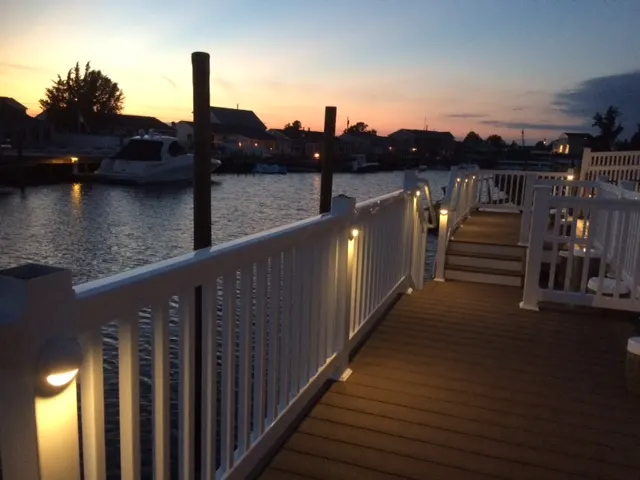
2. The walkway out. Not lit like a runway, and not floodlit from above. Low fixtures or recessed deck lights spaced loosely along the run so you can read the edge without staring into anything.
3. The pilings. This is the part that makes waterfront lighting look like waterfront lighting. Small fixtures on the pilings, aimed down at the water, give you the reflection off the surface that reads as “waterfront” from the house, from the yard, and from a boat coming in.
4. The seawall. A wash along the seawall face defines the edge of the property after dark and does more for the view from the house than almost anything else, because it draws the line where land stops.
5. The dock itself. Post caps, rail lighting, or recessed lights in the decking, depending on what the dock is built from and how you use it.
Anything past that is preference. Those five cover safety and the look, in that order.
Why less light is the right answer here
On a dock, your eyes are doing something they do not do in a yard: constantly adjusting between a lit surface and open black water. Every bright source you add makes the water darker by comparison, because the pupil closes to the brightest thing in view.
That is the argument against the floodlight, and it is a practical one rather than an aesthetic one. A dock lit with several small warm sources is genuinely easier to move around on at night than the same dock lit with one bright one, even though a light meter would say the floodlit version is brighter.
The same logic applies to color temperature. Cool white reads as harsh over water and kills the reflection. Warm white keeps it.
Salt is most of the job
Everything above is design. This part is why waterfront installs fail.
A canal-front property in Hudson, out along the Gulf Harbors canals in New Port Richey, or on Clearwater’s Island Estates, sits in salt-laden air every day of the year. Wind carries it inland too, so being a few streets back from open water is not the exemption people assume it is.
What that means in practice:
- Fixture housings have to be rated for coastal exposure, not merely “outdoor”. Standard outdoor-rated aluminium will chalk, pit and eventually fail out here on a timeline measured in seasons, not years.
- Every connection has to be properly sealed the first time. A corroded splice on a canal home is the single most common reason we get called out to somebody else’s install. It is invisible on the day the job finishes and it is a service call every spring afterwards.
- Low voltage is not optional near water. A 12-volt system is the right answer on a dock for reasons that should be obvious, and it is what any competent installer will specify.
- Mounting hardware matters as much as the fixture. Stainless fasteners, or you are replacing them.
None of this is visible in a quote and all of it decides whether the system is still working in year five. It is the main reason a cheap waterfront quote is usually the expensive one.
Docks are where outdoor audio actually earns its place
We install outdoor audio alongside dock lighting more often than anywhere else on a property, and the reason is straightforward: the dock is where people sit. It is the part of a waterfront home that gets used in the evening.
The same salt rules apply. A speaker that sounds thin or gives up after one season was not worth mounting, and marine-grade is the baseline rather than the upgrade. Done properly the speakers are as discreet as the lighting, which is to say you notice the sound and not the hardware.
What changes by where you are
Canal properties (Hudson, the Gulf Harbors neighborhoods, much of Holiday) usually have a dock right behind the house and a short run out. The whole scene is compact, the salt exposure is heavy, and the transition from yard to dock is the highest-value fixture on the property.
Open-water and bay properties (Island Estates and Sand Key in Clearwater, Snell Isle in St. Petersburg, Davis Islands and Culbreath Isles in Tampa) tend to have longer approaches, a seawall that is a genuine feature, and a view that is worth composing rather than just illuminating. These are the properties where seawall wash and piling lights do the most work.
Lakefront (Keystone, Lake Tarpon in Palm Harbor, the Ivy Lake Estates lakes in Odessa) skips the salt problem almost entirely, which widens what is possible and moves the budget from surviving the environment into the design itself.
Common questions
Do I need a permit? Dock work and anything attached to a seawall can fall under local and county rules, and some waterfront communities have their own architectural standards on top of that. We check before we design rather than after, and it is worth asking the same of anyone quoting you.
Will lights on the dock attract bugs? Warm white attracts noticeably fewer insects than cool white or bluish light. It is one more practical argument for warm, alongside the fact that it looks better.
Can lighting go on a floating dock? Yes, with the run and connections detailed for movement. It is a different install from a fixed dock and it should be quoted as one.
What about lighting under the water? Underwater fixtures are a separate category with their own rules, and they are not what most people actually want. Piling lights aimed down at the surface give you most of the effect people are picturing, at a fraction of the complexity.
Is this the same as landscape lighting? It is the same family and often the same transformer, but the fixture specification is different because of the salt, and the design priorities are different because the water is the feature. Our dock lighting and outdoor audio page covers what we install, and the landscape lighting page covers the rest of the property.
If you want to know what your own waterfront would look like lit properly, the design consultation is free and you get one written price with no obligation.
Want this on your home?
Book a free design consultation. We will walk your property, design the look around your rooflines, and hand you a clear written quote with no obligation.